Circadian Rhythm Sleep-Wake Disorders (Part 3): Diagnosis and Treatment
In Part 1 and part 2 of this series, we explored how the body’s internal clock regulates sleep and the different types of circadian rhythm sleep-wake disorders. Today is the final article of our 3 part series on Circadian rhythm sleep-wake disorders.
The encouraging news is that many circadian rhythm disorders can improve with appropriate treatment. However, successful treatment depends on identifying the correct diagnosis. The best approach for someone with delayed sleep-wake phase disorder may be quite different from the treatment for shift work disorder or advanced sleep-wake phase disorder.
Why is an accurate diagnosis important?
Many sleep disorders can produce similar symptoms, including:
- Difficulty falling asleep
- Waking at unwanted times
- Daytime fatigue
- Poor concentration
- Low energy
- Irritability
Circadian rhythm sleep-wake disorders are just one possible cause. Similar symptoms may also be due to insomnia, obstructive sleep apnoea, restless legs syndrome, narcolepsy, medication side effects, medical conditions, or mental health conditions.
It is also possible for more than one sleep disorder to occur at the same time. For this reason, a careful assessment is often the most important first step.
What happens during an assessment?
Your doctor will usually begin by asking detailed questions about your sleep pattern and daily routine.
Topics may include:
- Your usual bedtime and wake time
- How long it takes to fall asleep
- Whether your sleep schedule changes on weekends
- Your work or study schedule
- Daytime sleepiness
- Caffeine, alcohol, nicotine, or other substance use
- Medical conditions
- Current medications
- Symptoms of anxiety, depression, ADHD, bipolar disorder, or other mental health conditions
Understanding the pattern of your sleep over time is often more helpful than focusing on a single bad night.
Keeping a sleep diary
One of the simplest and most useful assessment tools is a sleep diary.
For one to two weeks, you may be asked to record information such as:
- When you went to bed
- Approximately when you fell asleep
- Night-time awakenings
- Wake-up time
- Daytime naps
- Caffeine or alcohol intake
- Shift work or unusual schedules
A sleep diary can reveal patterns that are not always obvious during a consultation.
Actigraphy and other sleep investigations
Sometimes your healthcare professional may recommend additional investigations.
One commonly used tool is actigraphy, which involves wearing a small wrist device that records movement over several days or weeks. This provides information about your sleep-wake pattern in your normal environment.
Depending on your symptoms, further investigations may occasionally be recommended. For example, if another sleep disorder such as obstructive sleep apnoea or narcolepsy is suspected, referral to a sleep physician and overnight sleep studies may be appropriate.
Not everyone requires these tests, and many people can be diagnosed based on a careful clinical assessment.
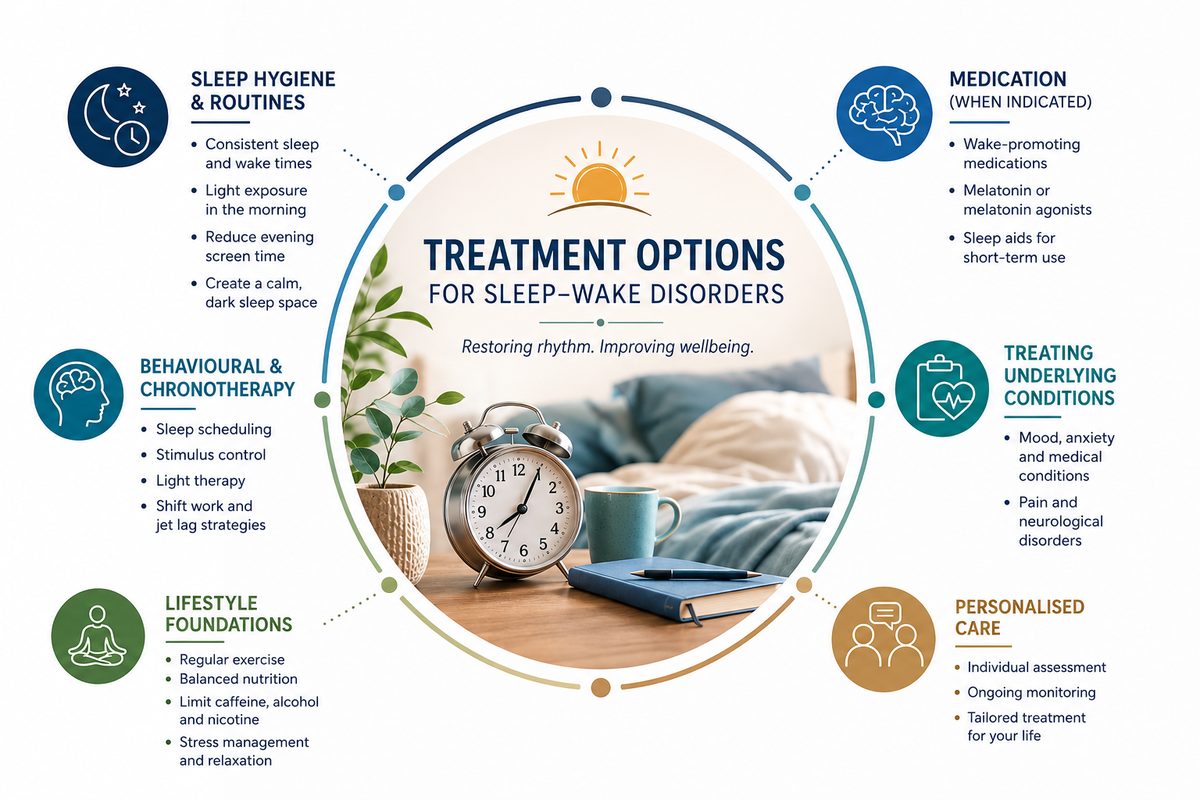
How are circadian rhythm sleep-wake disorders treated?
Treatment depends on the specific disorder, your lifestyle, your work commitments, and any other medical or mental health conditions that may be present.
A combination of approaches is often most effective.
Maintaining a consistent sleep schedule
One of the foundations of treatment is keeping a regular sleep-wake schedule.
This usually means:
- Getting up at approximately the same time each day
- Going to bed consistently
- Avoiding large differences between weekdays and weekends where possible
- Allowing enough time for adequate sleep
Regular routines help reinforce the body’s natural circadian rhythm.
Managing exposure to light
Light is the strongest signal that helps regulate the body’s internal clock.
Depending on the specific circadian rhythm disorder, treatment may involve increasing light exposure at certain times of day while reducing exposure at others.
Examples may include:
- Spending time outdoors in natural morning light
- Reducing exposure to bright light late in the evening
- Limiting screen use close to bedtime where appropriate
The timing of light exposure is often just as important as the amount of light.
Bright light therapy
For some people, carefully timed exposure to bright artificial light may help shift the body’s internal clock.
Bright light therapy may be recommended for certain circadian rhythm disorders, particularly delayed sleep-wake phase disorder and some cases of shift work disorder.
However, the timing of treatment is critical. Using bright light at the wrong time of day can sometimes worsen symptoms or shift the body clock in the wrong direction.
For this reason, bright light therapy should ideally be undertaken following professional assessment and guidance.
What about melatonin?
Melatonin is a hormone naturally produced by the brain, particularly in the evening as light levels decrease.
Melatonin supplements may be recommended for some circadian rhythm sleep-wake disorders.
As with light therapy, timing is often more important than the dose. Taking melatonin at the wrong time may reduce its effectiveness or produce unwanted effects.
Melatonin is not appropriate for everyone, and treatment should be individualised.
Managing shift work
When changing work hours is not possible, treatment often focuses on reducing the impact of shift work on sleep.
Strategies may include:
- Establishing consistent sleep routines where possible
- Managing exposure to light during and after shifts
- Creating a dark, quiet sleep environment during the day
- Limiting unnecessary disruptions during planned sleep periods
- Using caffeine thoughtfully and avoiding it close to intended sleep times
Because every workplace and roster is different, management plans often need to be tailored to the individual.
Looking after your overall health
Circadian rhythm disorders rarely exist in isolation.
Improving sleep may also involve addressing:
- Anxiety
- Depression
- Bipolar disorder
- ADHD
- Chronic pain
- Medical conditions affecting sleep
- Alcohol or substance use where relevant
Treating these conditions can improve sleep, while improving sleep may also support better mental and physical health.
Frequently asked questions
Can circadian rhythm disorders be cured?
Some people experience substantial improvement with treatment, while others learn strategies to better manage a long-term tendency for their body clock to run earlier or later than average. The outlook varies depending on the type of disorder and the individual.
Should I take sleeping tablets?
Sleeping medication is not the primary treatment for most circadian rhythm sleep-wake disorders. In many cases, the difficulty is not an inability to sleep, but a mismatch between the body’s internal clock and the desired sleep schedule. The most appropriate treatment depends on the underlying cause of the problem.
Is melatonin safe because it is “natural”?
Although melatonin is a naturally occurring hormone, supplements are still medicines and should be used appropriately. They may not be suitable for everyone and should be discussed with your healthcare professional.
Could my mental health be affecting my body clock?
Yes. Conditions such as depression, bipolar disorder, anxiety disorders, and ADHD can all influence sleep timing. Likewise, persistent disruption of the sleep-wake cycle may worsen mood, concentration, and emotional wellbeing. This is one reason why sleep assessment forms an important part of psychiatric care.
When should you seek professional help?
You should consider seeking medical advice if:
- Your sleep schedule consistently prevents you from functioning at work, school, or home.
- You regularly struggle to fall asleep or wake up at the times you need to.
- You experience excessive daytime sleepiness.
- Your symptoms have persisted despite trying sensible sleep habits.
- You have symptoms that suggest another sleep disorder, such as loud snoring, witnessed pauses in breathing during sleep, sudden episodes of falling asleep, or uncomfortable sensations in your legs at night.
- Your sleep difficulties occur alongside symptoms of depression, anxiety, bipolar disorder, or another mental health condition.
Key take-home messages
Circadian rhythm sleep-wake disorders are disorders of sleep timing, rather than simply disorders of sleep itself. Many people can sleep well when allowed to follow their body’s preferred schedule, but experience significant difficulties when their internal clock does not match the demands of everyday life.
Accurate diagnosis is important because treatment varies according to the specific disorder. Depending on the circumstances, management may include adjustments to daily routines, carefully timed light exposure, melatonin, treatment of contributing medical or psychiatric conditions, or referral to a sleep physician.
If you think your body clock may be affecting your sleep, an assessment can help identify the cause and guide the most appropriate treatment.
This was the final article of a 3-part series on circadian rhythm sleep-wake disorders. You can find Part 1 here and part 2 here.
This article is intended for general educational purposes only and should not be used as a substitute for individual medical advice, diagnosis, or treatment. If you have persistent sleep problems, excessive daytime sleepiness, or concerns about your physical or mental health, consult an appropriately qualified healthcare professional.